
Décote PEB en Belgique : comment le label énergétique impacte le prix de votre bien en 2026
En Belgique, une maison classée A se vend jusqu'à 18,6 % plus cher qu'une D comparable. Impact mesuré du label énergétique sur les prix en Wallonie, à Bruxelles et en Flandre — coefficients 2026.
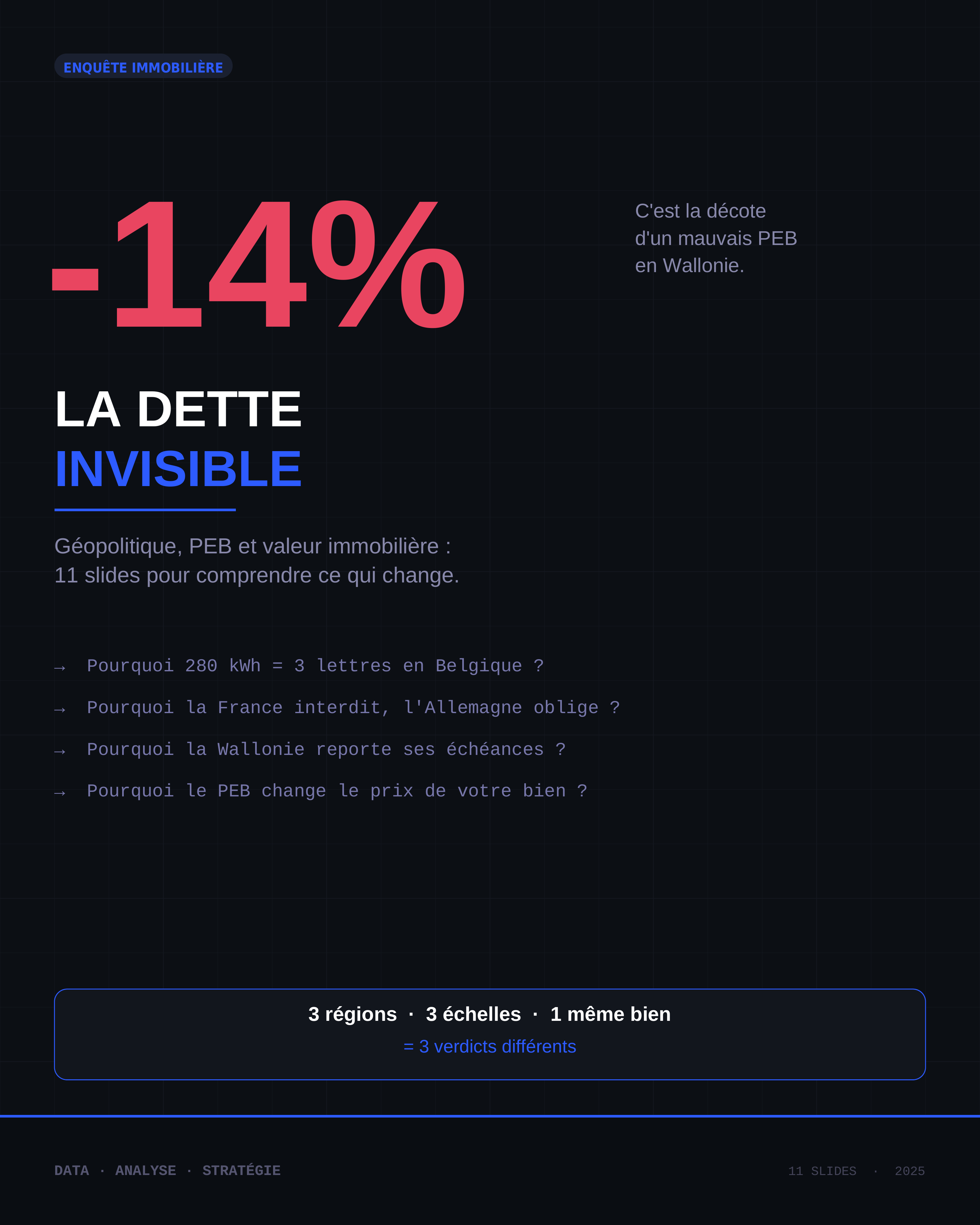
En Belgique, à caractéristiques égales, une maison classée A se vend en moyenne 18,6 % plus cher en Flandre qu'une maison comparable classée D — et 12 % plus cher en Wallonie. À l'inverse, les biens énergivores décotent : −10,4 % pour un F flamand, −8,3 % pour un G wallon. Ce n'est plus une projection — ce sont des écarts mesurés sur les transactions (étude Immoweb 2026, à type de bien, localisation et surface comparables).
Ce que révèlent ces données : le label énergétique est devenu un paramètre de prix au même titre que la surface ou la localisation, et les trois régions belges ne jouent pas la même partition — ni dans les écarts de prix, ni dans les règles. Un bien identique à 280 kWh/m².an reçoit un label C en Flandre, D en Wallonie, et F à Bruxelles. Un investisseur qui ignore cette double réalité prend un risque patrimonial mesurable. Nous avions publié une analyse complète en 11 slides sur LinkedIn — cet article la met à jour avec les coefficients 2026.
Ce que vous allez apprendre dans cet article
- L'impact mesuré du PEB sur le prix d'un bien, région par région, en 2026
- Pourquoi les trois régions donnent trois labels différents pour une même consommation
- Comment la réglementation a transformé le label en paramètre financier
- Quelle stratégie adopter selon que votre bien est en Flandre, en Wallonie ou à Bruxelles
- Comment simuler le vrai coût d'une passoire énergétique avant d'acheter
La décote brune : les écarts mesurés en 2026
Ce que le label PEB pèse réellement sur le prix
La « décote brune » — la perte de valeur liée à un mauvais label — et son miroir, la prime verte, se mesurent désormais avec précision. Les écarts ci-dessous sont issus de l'étude Immoweb 2026, à caractéristiques égales, et sont ceux que notre moteur d'estimation applique après calibration sur les grilles régionales officielles :
| Région | Écart mesuré | Comparaison |
|---|---|---|
| Flandre | +18,6 % | maison A vs D |
| Wallonie | +12 % | maison A vs D |
| Bruxelles | +12,2 % | label B vs D |
| Flandre | −10,4 % | label F vs D |
| Wallonie | −8,3 % | label G vs D |
D'autres baromètres convergent vers les mêmes ordres de grandeur : Test-Achats mesurait −11,7 % pour un F flamand en 2025, et le Baromètre des Notaires 2024 estimait la décote des passoires bruxelloises entre −15 et −20 % selon les quartiers. Les méthodologies diffèrent, la direction jamais : chaque mesure successive confirme que le marché pénalise les biens énergivores — et la pression réglementaire ne va que dans un sens.
Sur une maison wallonne à 350 000 € en classe D, l'écart entre un A et un G comparables représente ainsi environ 70 000 € — pour le même bâtiment, à la performance énergétique près.
Pourquoi l'Europe accélère le mouvement
La directive européenne EPBD III (2024/1275) oblige les États membres à imposer des obligations de rénovation sur les passoires énergétiques. Mais c'est l'invasion de l'Ukraine en février 2022 qui a tout basculé : avant, la transition énergétique était pilotée par la Commission avec 2050 comme horizon et des leviers incitatifs ; après, les États ont pris le contrôle avec 2030-2035 comme nouvelle échéance. Ce qui devait prendre dix ans s'est décidé en dix mois.
La comparaison européenne confirme la direction : en France, les labels G sont interdits à la location depuis 2025 et les décotes atteignent −25 % dans certaines régions ; en Allemagne, le GEG 2024 impose 65 % d'énergies renouvelables pour tout nouveau chauffage ; aux Pays-Bas, les banques ajustent directement leurs taux de crédit selon le label.
Le piège des 280 kWh : trois régions, trois labels différents
C'est le point le plus sous-estimé par les acheteurs et investisseurs belges. 280 kWh/m².an donne trois labels différents selon la région — et donc trois impacts prix différents.
| Région | Part du parc avant 1945 | Label pour 280 kWh/m².an | Statut |
|---|---|---|---|
| Flandre | 25,8 % | C | Conforme |
| Wallonie | 47,4 % | D | Zone d'alerte |
| Bruxelles | 65,5 % | F | Non-conforme |
Chaque région belge a calibré son échelle PEB sur l'âge de son propre parc immobilier. Un bien C en Flandre et un bien F à Bruxelles peuvent avoir exactement la même consommation réelle. Un investisseur qui compare les labels d'une région à l'autre sans cette clé de lecture se trompe structurellement sur la valeur.
Impact par région : écarts mesurés, obligations et leviers concrets
Flandre : le marché a déjà intégré le PEB
En Flandre, le signal prix anticipe la loi : +18,6 % pour un A vs D, −10,4 % pour un F — les écarts les plus marqués du pays. La fenêtre de négociation sur les biens D-E se referme progressivement.
Obligations actuelles : label D minimum obligatoire dans les 6 ans suivant l'achat. Assouplissement en 2025 avec report de l'obligation A à 2045.
Levier : primes de rénovation jusqu'à 15 000 €. Amende progressive en cas de non-conformité persistante.
Wallonie : le timing joue en faveur de l'acheteur informé
Les obligations de rénovation à la vente ont été reportées en Wallonie — ce qui crée un décalage temporaire entre le risque réel et le prix de marché. La décote y est réelle (−8,3 % pour un G vs D) mais moins prononcée qu'en Flandre : le marché wallon n'a pas encore intégré toute la contrainte à venir.
Levier fiscal exceptionnel : les droits d'enregistrement réduits (12,5 % → 3 % pour l'habitation propre et unique) représentent une économie de l'ordre de 26 000 € sur un achat à 275 000 €.
Bruxelles : contrainte maximale, demande locative aussi
Avec 93 % du parc antérieur à 1981, Bruxelles est la région la plus exposée : 65 % du parc bruxellois sera non-conforme en 2033. Le marché y valorise déjà la performance (+12,2 % pour un B vs D), et les baromètres notariaux mesurent des décotes de −15 à −20 % sur les passoires selon les quartiers.
Obligations : label E minimum obligatoire en 2033, label C en 2045.
Simulation patrimoniale : rénover une passoire wallonne
La rénovation n'est pas une dépense — c'est un repositionnement patrimonial. Voici une simulation avec les écarts mesurés 2026, sur un bien wallon classé G.
Hypothèse : maison wallonne qui vaudrait 300 000 € une fois rénovée (label B), actuellement classée G.
| Poste | Montant estimé |
|---|---|
| Prix d'achat réel (décote G, −8,3 % appliquée au segment) | ~275 000 € |
| Rénovation G → B (isolation, pompe à chaleur…) | −60 000 à −90 000 € |
| Primes régionales récupérables | +10 000 à +20 000 € |
| Économie droits d'enregistrement (3 % vs 12,5 % sur 275 000 €) | ~26 000 € |
| Investissement total net | ~299 000 à ~319 000 € |
| Valeur post-rénovation (label B) | ~300 000 à ~330 000 € |
La lecture honnête de ce tableau : l'opération ne dégage pas un profit spéculatif — le gain vient des primes et du levier fiscal wallon, et il protège contre l'érosion programmée de la valeur d'un bien non rénové, dont la décote ne peut que croître à mesure que les échéances réglementaires approchent. Le calcul bascule bien plus favorablement si le devis réel sort sous la fourchette haute — d'où l'importance de le faire établir avant l'offre.
Simulation indicative. Consultez un auditeur agréé pour un devis personnalisé.
6 points clés à retenir sur le PEB et l'immobilier belge
- La décote brune est un fait de marché mesuré — jusqu'à −10,4 % en Flandre pour un F, et des écarts A vs D qui atteignent +18,6 %.
- L'âge du bâti dicte les règles PEB — 47 % du parc wallon et 65 % du parc bruxellois construits avant toute norme thermique.
- 280 kWh = trois labels différents selon la région — la comparaison inter-régionale est faussée sans cette clé de lecture.
- La géopolitique a tout accéléré — 2022 a transformé la transition énergétique en question de souveraineté nationale.
- Chaque région offre un levier spécifique — maturité du marché en Flandre, timing fiscal en Wallonie, demande locative à Bruxelles.
- Estimer sans intégrer le PEB, c'est fausser l'analyse — le label est un paramètre de prix au même titre que la superficie ou la localisation, et son poids se mesure région par région, jamais nationalement.
Intégrez le PEB dans votre analyse immobilière avec Arcanes
Le label PEB fait partie des paramètres analysés automatiquement dans chaque rapport Arcanes, avec les coefficients régionaux 2026 présentés dans cet article. En entrant l'URL d'une annonce Immoweb, vous obtenez une analyse complète intégrant le positionnement énergétique du bien, les obligations réglementaires applicables par région, le rendement net et net-net, et les données de marché de la commune.
→ Analyser un bien gratuitement sur arcanes.be
Analyse gratuite · Données actualisées · Aucun engagement
Propriétaire vendeur plutôt qu'investisseur ? Deux ressources : notre analyse faut-il rénover son PEB avant de vendre, et votre estimation immobilière gratuite — avec le simulateur de rénovation PEB calculé pour votre commune.
Sources : étude Immoweb 2026 (écarts à caractéristiques égales) · Statbel · Baromètre des Notaires 2024 · Test-Achats 2025 · SPW Énergie · Bruxelles Environnement · VEKA · Directive EPBD III (2024/1275) · GEG 2024 · Loi Climat FR. Les données et simulations présentées sont indicatives et ne constituent pas un conseil en investissement. Consultez un professionnel agréé pour une analyse personnalisée.